The Safety Net – Volume 1, Issue 3 (May 2009)

Safe Havens International – The Safety Net Newsletter


_ Safe Havens International Presents . . .

The Safety Net 

Issue 3 Volume 1; May 2009  
 

In this Issue:

Effective Crisis Response Teams
by Michael Dorn

Evacuation Tips for Schools and Childcare Facilities
by Sonayia Shepherd

In Each Issue . . .
Hazards in Plain View: Developing Your Sixth Sense for School Safety

Quick, what do we do?: Sample Tabletop Exercise Scenario

News Briefs

Free Resources

Don’t forget to give us suggestions or tell us what you’d like to see covered in an upcoming edition. If you would like to recommend this newsletter to a friend please tell them to sign up using our newsletter signup form.

If you haven’t seen them already, take a look at our video blogs. Each blog spends a few minutes exploring topics of common concern to campuses. Below is one covering Emergency Evacuation Kits for Schools:

If you are connected to the internet but cannot see the video, you can access it here.

To view our other blogs, visit our video blog page. To view all of our blogs and other videos, subscribe to our channel on youtube.


Effective Crisis Response Teams
By Michael Dorn,
Safe Havens International


This is an abbreviated version of the full article, which was taken from the collection “Let None Learn in Fear” by Michael Dorn. Click here for a free PDF download of this 205 page eBook. For the full text of this article see pages 189-191.


Emergency Preparedness Checklist for Schools
By Sonayia Shepherd, Chief Executive Officer, Safe Havens International, Inc.

The following list should help you assess your preparedness for disasters, natural as well as man-made:

  1. Do you have a disaster preparedness plan?
  2. Have you done a threat assessment analysis to determine vulnerability to deliberate acts against your campus?
  3. Have you instituted plans to assess structural hazards? Non-structural hazards?
  4. Do you have an evacuation plan? If so, do you review this plan periodically to ensure its worthiness?
  5. Are students, faculty and staff within your organization familiar with your evacuation plan? Are new hires made aware of it as part of the orientation?
  6. In the event of an evacuation, have you determined building functions to be turned off and designated staff to do so?
  7. Do you have at least one staff member in every work location able to administer first-aid and CPR?
  8. Have you designated crisis teams to assist in disasters?
  9. Have you designated a disaster recovery team to manage the situation during and after the event?
  10. Do your faculty and staff know locations of designated sites in your community for first aid after disasters?
  11. Have you designated criteria for evacuation?
  12. How will staff be notified of evacuation?
  13. Is there a system for tracking who has been evacuated and who still remains in the building?
  14. Does the school maintain daily records of visitors, in addition to staff, in the building?
  15. Have you done a full-scale exercise of your evacuation plan?
  16. Have you set up communication lines to stay in touch with faculty and staff after evacuation?
  17. Do employees and students know the consequences—from termination to imprisonment—of calling in false bomb threats and other messages designed to halt classes and inflict terror?
  18. Depending on the cause of an evacuation, have you plans that cover review of premises after the fact to ensure they are safe for re-occupation?
  19. Have you in place a program to help students, faculty and staff address the emotional response to the hazardous situation?

If you have answered no to any of the questions, you need plans developed.  We can help. Call our consultants.  Don’t delay – our children deserve no less!

For more information on four phase all hazards planning, see our article on the subject.


Columns

Hazards in Plain View: Developing Your Sixth Sense of School Safety

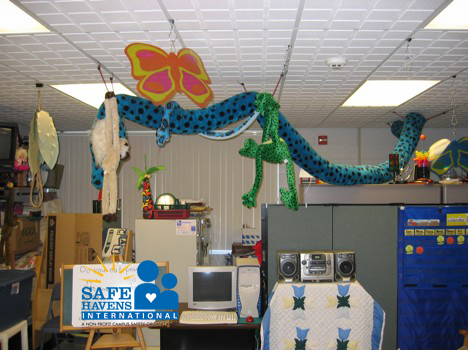
Each month we will feature a photo illustrating a hazard and how to fix it or a positive example of ways to improve your school’s safety and environment.

What’s wrong with this picture?

Fire hazard

Answer: The items hanging from the ceiling are in violation of the fire code.  If these articles were to catch fire, they might cause the flames to burn through the ceiling tiles and allow the fire to spread throughout the structure.  There is also too much clutter in the room for a safe and orderly emergency evacuation, and items are stacked in a dangerous manner, particularly since the room serves small children. While we can appreciate this teacher’s creativity in making the classroom a welcoming environment, we must always consider the safety implications of our actions.

For examples and training on how to conduct a Site Survey of your facility, check out the Tactical Site Survey Power Point slide show in our Free Resources section. While our examples are taken from schools, it is not hard to find applications for this technique in any field.

Have a photo that you think should be featured in this column? E-mail it to us and if we feature it we’ll send you a free book. Remember that both positive and negative examples are welcome.


Quick, What do we do?
A Sample Tabletop Exercise Scenario

What is a Tabletop Exercise?
A focused exercise designed to test and determine gaps in your existing crisis plan.

FEMA recommends that emergency response plans be tested using a graduated series of exercises (Orientation, Drills, Tabletop Exercise, Functional Exercise, Full Scale Exercise). To use this scenario, gather staff members from various roles (administration, teachers, office staff) in a room and give them the scenario (but not beforehand, so as to simulate the surprise of a real crisis). The team then talks through the various steps that would be taken in response to this incident. If any outside agencies would be called or involved, contact them and ensure that their response will be able to meet your expectations. During a Full Scale exercise (the last step in the testing process, which FEMA recommends 12-18 months of pre-preplanning) these outside agencies would preferably be directly involved in the exercise in real time.

Student Committing Suicide in Front of School
(High school level)

It is Monday during the first week of school, as students are arriving for the day, a male student exits his vehicle in the parking lot, goes to the trunk of his car and removes a shotgun.  While a dozen astonished students watch, he places the butt stock of the gun on the ground, inserts a long stick in the trigger guard, places the muzzle of the weapon in his mouth and steps on the stick, discharging the weapon.  The scene is gory as there is severe trauma to his head and students instantly become very upset.  By the time the first school official arrives at the site, a dozen more students have arrived and are approaching the group of distraught students who are standing around the body.

Each month we will feature a different exercise (tabletop or functional) to give you ideas for your own emergency plan testing program. For more information on testing your plans with drills and exercises, check out the free FEMA Independent Study course IS-139 or our training offerings.

News Briefs 

Atlanta, Georgia A federal judge dismissed the lawsuit of a high school student who was suspended for 10 days after bringing to school a story she had written about a dream in which a student shoots her 6th period math teacher. The student, who also happens to take math during 6th period, was initially expelled before her sentence was reduced to 10 days of suspension. The U.S. District Judge in the case determined that the writings were “sufficiently disturbing” and supported the school’s actions. Source: CNN, Associated Press 8/3/06

Beijing, China –More than 200 primary school students were hospitalized in the most recent of 185 food poisoning cases since June. The high frequency of incidents is due to lax food preparation supervision, which allows contractors to cut costs but has resulted in thousands of cases of food poisoning this year. The latest case, which filled three floors of a local hospital, was the result of a lunch served on Friday. Students began having symptoms over the weekend including headache, fever, diarrhea and vomiting, but none of the cases were fatal. Like similar cases in the United States that we see occur every year, this illustrates the need for increased food safety and supervision, a measure that not only protects against food poisoning and contamination but against malicious acts by disgruntled students or terrorists. Source: CNN 9/03/06

Free Resources

This month we are featuring our grant resources page. This page features our Grantwriting FAQs and tips, a list of suggested grants for schools working to improve safety, as well as links to other sites with helpful information on grants and finding money for safety.

Our Grant Resources Page


All content copyright 2009 Safe Havens International. Any unauthorized reproduction is forbidden. For reprint permission contact chris@weakfish.org.


The Safety Net is a free e-newsletter designed to help you build a safety net to make your schools safety & more inviting for all students and staff members.

Each issue will feature articles, regular columns on safety hazards and drug abuse, helpful tips and free resources to aid you as an advocate for the children.For info on having your writing featured in The Safety Net please contact us. For more information about Safe Havens International (publisher of The Safety Net) click here.


Featured product of the Month:

Jane’s Safe Schools Planning Guide
for All Hazards
by Michael Dorn, Sonayia Shepherd, Greg Thomas and Marleen Wong
(2004, 450 pages)

Jane’s Safe Schools Planning Guide for All Hazards is a textbook-sized reference for school planners tasked with designing, implementing and maintaining a safe school plan.

Contents include:

– Safe school standards, roles and responsibilities

– Prevention/mitigation, preparedness, response and recovery strategy development

-Characteristics of violent youth

-Vulnerability and threat assessments for schools

-Training, education, evaluation and exercises

-Developing contact lists

-Disaster planning

-Preparing for and managing stress


The Safety Net – Volume 1, Issue 2 (December 2006)


 Safe Havens International, Inc – http://www.safehavensinternational.org
_ Safe Havens International Presents . . .

The Safety Net 

Issue 2 Volume 1; Spring 2007  

In this Issue:

Business Continuity Planning for Schools and Communities
by Sonayia Shepherd


Recovery Planning for Educational Facilities
by Sonayia Shepherd

In Each Issue . . .
Hazards in Plain View: Developing Your Sixth Sense for School Safety

420: Recognizing Signs of Student Drug Abuse

Quick, what do we do?: Sample Tabletop Exercise Scenario

News Briefs

Free Resources

Have a question that you’d like us to answer? E-mail us and we may include the response in our next issue.


Multiple Victim Casualty Incidents Show Need for  Written Recovery Plans

The tragic crash of the bus carrying Bluffton University’s baseball team in Atlanta on the morning of March 2, 2007 and the grievous loss of life following the destruction of  Enterprise High School in Alabama the day before demonstrate the importance of a detailed and comprehensive recovery plan in written form.  Unfortunately, many public and independent K-12 schools, colleges and universities still do not have a written recovery plan.  More still have only one out of the two plan sections recommended by the United States Department of Education (USDOE) in their recovery plan.  The devastating tornado strike on Enterprise HS is the fourth incident we are aware of this year where a
K-12 school has been destroyed or severely damaged, and the Atlanta bus crash comes only three months after the shocking high school bus crash in Alabama that left four dead and many others wounded.  Having a written mental health recovery plan as well as a written business continuity plan are a must for schools and school systems that want to have a truly effective four- phase school crisis plan.  The incident at Enterprise HS also reminds us of the need to design schools in a manner reflective of local hazards.  While design features cannot fully protect occupants from every catastrophic event or hazard, they can dramatically improve the level of safety of occupants in the event of a catastrophic event like an earthquake or tornado.  Several upcoming training sessions, including an advanced level seminar at the University of Louisville, will address the safest design features of K-12 and higher education facilities and how to use proven practices to prevent violent incidents using an all hazards approach (for more information click here).

This issue of The Safety Net focuses on resources to help you plan for and respond to incidents like these, including information on Business Continuity and Recovery Planning for educational facilities and communities. If you have any questions or comments about these topics or another school safety issue please feel free to contact us.


Business Continuity Planning for Schools & Communities

By Sonayia Shepherd, CEO, Safe Havens International

This article is modified from the Business Continuity Plan Template from Safe Havens International, Inc.

Whenever disaster strikes, the most critical asset that every school must protect from sudden loss is their human resources (the people that occupy the building) and their data.    No matter what happens, schools must be capable of maintaining operations no matter how sudden or how severe the damage or loss is.  By creating a Business Continuity Plan schools are increasing their level of preparedness and maintaining a continuity of operations that is a basic requirement of any effective educational facility.

Scope of the Business Continuity Plan

The objective of School Business Continuity Planning (BCP) is to restore critical systems and the restore the learning environment immediately.  
Planning for the business continuity of a school system or a university in the aftermath of a disaster is a complex task. Preparation for, response to, and recovery from a disaster affecting administrative functions requires the cooperative efforts of many support organizations, in partnership with the functional areas supporting the “business” of your organization. The BCP outlines and coordinates all efforts to restore the staff & community of your organization post-disaster.

BCP Components

I           Outline of Technology Systems within the school (including back up systems)

II         Outline of essential data and activities necessary to maintain the school. This comprises the overall structure of the BCP.

III
       General responsibilities of the individual Information Technology Support Teams that together form the Business Continuity Management Team, emphasizing the function of each team and its preparation responsibilities in respect to restoring the essential functions outlined in Part II (above).

IV
       Recovery actions for the Information Technology Support Teams and important checklists such as the notification list for a disaster and an inventory of resources required for the environment. [Note: If a “disaster” situation arises, Section IV of the Plan is the only section that needs to be referenced. It contains all of the procedures and support information for recovery.]

This is an abbreviated version of the full article, which can be found here. For
information on our planning templates, which can assist you by
providing an All Hazards Four Phase framework to guide you in designing
your Crisis Plan, visit our Template Information page.


Crisis Recovery Planning for Educational Facilities

By Sonayia Shepherd, CEO, Safe Havens International, Inc.

Modified from the “School Crisis Recovery Plan Template”  

A Recovery Plan is an integral part of the four phase crisis planning process. Every recovery plan should be designed to ensure the continuation of vital emotional and cognitive processes in the event that a disaster occurs or a major crisis event affects the psyche of students, faculty and staff. The Crisis Recovery Plan can assist the school system in providing effective emotional health services that can be used to help individuals recover from a crisis event, provide procedures to handle emergency situations that may have an emotional impact on people, and to accomplish the following objectives:

  • Prepare crisis team members to respond effectively in a crisis situation.
  • Manage the crisis recovery activities in an organized and effective manner.
  • Limit the emotional impact of any crisis situation.

Should an emergency situation occur at any educational facility, the school’s recovery efforts should be tailored to provide an effective method that can be used by crisis team members to control all activities associated with the crisis situation in a proactive manner and to lessen the potential negative impact with the media and the community at large. It is important to review the plan carefully to ensure that it includes:

  • Documentation for each responsibility.
  • Procedures and checklists that will be used to manage and control the situation following an emergency or crisis occurrence.
  • Forms that will be used to document activities.

In any event, your Recovery Plan is one element of developing a strategy. The plan’s success, however, depends upon:

  1. Implementation of the recommendations made by a group of local experts to include community mental health officials, emergency management personnel and public health representatives. It is essential to commit to implementing all recommendations and strategies identified in the Recovery Plan, otherwise investment made in its preparation will be redundant. Similarly, training and awareness must be embarked upon to ensure that the entire school community is confident and competent concerning the plan.
  2. A program of training of those directly involved in the execution of the plan. All parties must appreciate the importance of the school’s Recovery Plan to the operation’s survival and their role in this process.
  3. An education and awareness program to ensure district-wide understanding and adoption of the plan, covering internal and external stakeholders, i.e. employees, students, and parents. This awareness should extend to parents and other stakeholders upon whom the school system depends or has influence in both normal and crisis operations.

Finally, your plan should be updated annually, exercised and should always be readily available to authorized personnel.

This is an abbreviated version of this article. For the full article including a detailed outline of the three step recovery process, click here.


Columns

Hazards in Plain View: Developing Your Sixth Sense of School Safety

Each
month we will feature a photo illustrating a hazard and how to fix it,
or alternatively a positive example of ways that schools have improved their safety and
environment.

What’s wrong with this picture?


Answer: 
This is one of the most common hazards we see at any facility, not just educational institutions. Not only could this serve as a weapon, but more importantly it is an invitation to prop the door open, thus bypassing any benefit of the self-locking door. While of course it is sometimes necessary to prop a door open for short periods of time, leaving any item near the door that allows it to be easily propped increases your chances of having a violent incident involving an intruder in the school. At the very least this type of debris detracts from the overall cleanliness of the campus and should be avoided.

For examples and training on conducting Site Surveys of your
facility, please see the Tactical Site Survey slide show in
our Free Resources section. While most examples are taken from schools, it is not hard to find applications for this technique in any facility or field.

Have a photo that you think should be featured in this column? E-mail it to us and if we feature it we’ll send you a free book. Remember that both positive and negative examples are welcome.


420: Recognizing Signs of Student Drug Abuse

What’s wrong with this picture?

This is an example of a common type of makeshift pipe that can be used
to smoke methamphetamine or crack cocaine. These are sold at gas stations as “Rose Tubes” for about $1 as a novelty item, but to the trained eye it is clear from the foil-covered end and the open other end that these are intended for a different use (why would only one end be sealed?). Coincidentally the sealed end is covered with foil, which is one component of homemade pipes similar to this one. In some cases stores have even been known to sell them by the slang name of “crack kits” in a paper bag along with a lighter and a piece of screen for the pipe. While there are obviously innocent uses for an item like this, and not every store selling them is doing so for this purpose, this item is certainly something to watch out for in context. Many store owners and operators appear to be unaware of this use, with one quoted as saying “I had no idea that’s what those were for, but I always wondered why they were kept beneath the counter with the tobacco products.”

If you have a photo that you’d like featured in this column e-mail us.

Quick, What do we do?

A Sample Tabletop Exercise Scenario

What is a Tabletop Exercise?
A focused exercise designed to test and determine gaps in your existing
crisis plan. For more information on conducting drills & exercises please see the end of this article.


A note about this month’s scenario:

While we included this scenario because of the recent incidents involving school & university buses, this is a scenario that was developed several years ago based on an actual incident in the Southeast. We also want to stress that the planning process should not focus too much on one type of incident (for example transportation accidents), but on an All Hazards approach to safety.

School bus on out of town field trip struck by commercial vehicle

It’s 8:04AM on a Saturday morning and you’ve just arrived at your crisis response team’s meeting location after being notified that a bus accident involving multiple fatalities has occurred.  Your team is briefed with the following available information:

-The bus was transporting students on a field trip to an amusement park in a neighboring state
-The accident took place on a highway that spans a river
-The bus was hit head-on by a large commercial truck
-Upon impact, the bus was thrown off of the bridge and landed upside down in the river about forty feet below, and is partially submerged.
-The driver of the truck has been charged with driving under the influence of alcohol.
-Rescue crews report that they have recovered all victims and bodies of victims from the bus.  They are dragging the river to ensure that there are no additional bodies and expect to complete that process later in the day.
-Fourteen children are reported to have been killed.
-The driver was reportedly killed.
-The three parent chaperones were all reportedly killed.
-Eight children have been transported to three different area hospitals for treatment, at least two are in critical condition.
-The incident is being widely reported on national and local media, with graphic helicopter footage showing the bus and the covered bodies of the children on the river bank

What do you do next?
-Death notification
-Media briefings
-Mental health recovery
-??

Each month we will feature a different exercise (tabletop or
functional) to give you ideas for your own emergency plan testing
program. For more information on testing your plans with drills and
exercises, check out the free FEMA Independent Study course IS-139 or our training offerings.

FEMA recommends that emergency response plans be tested using a
graduated series of exercises (Orientation, Drills, Tabletop Exercise,
Functional Exercise, Full Scale Exercise). To use this scenario, gather
staff members from various roles (administration, teachers, office
staff) in a room and give them the scenario (but not beforehand, so as
to simulate the surprise of a real crisis). The team then talks through
the various steps that would be taken in response to this incident. If
any outside agencies would be called or involved, contact them and
ensure that their response will be able to meet your expectations.
During a Full Scale exercise (the last step in the testing process,
which FEMA recommends 12-18 months of pre-preplanning) these outside
agencies would preferably be directly involved in the exercise in real
time.

News Briefs

Midland, MI – March 7, 2007
A 17 year old male committed suicide in a school parking lot after shooting his 17 year old girlfriend (a student at the school) four times. He reportedly came to the school to speak with her but was turned away by school staff. The girl’s mother had driven her to the school after the male convinced her to meet him there. Her condition is listed as unknown.
Source: WXYZ Action News Detroit

Greenville, TX – March 7, 2007 – A male student committed suicide by shooting himself in front of several other students shortly before classes started at Greenville HS. While this is truly a tragic incident, the school district can be applauded for having a strong recovery plan in place, since the school was able to remain in session for the remainder of the day. While this may seem insensitive to the death of the student, it is necessary for the recovery process, and more importantly, as stated by the superintendent: “We cannot service children if they are not with us.” The school did allow any parents who wished to pick up their children to do so, but with trained counselors and procedures in place to deal with such a situation, it is definately more effective to keep students than sending them to an often empty home for the rest of the day.
Source: Fox 11 AZ.com

Los Angeles, CA – March 8, 2007 – A male 11th grader at Centennial High in Compton was shot in the left elbow after an altercation with non-students in a common area of campus. The incident occurred about an hour after dismissal, and the injury was listed as minor.
Source: LATimes.com

Littleton, CO – March 8, 2007- Roughly six weeks before the eighth anniversary of the shooting at Columbine HS, the school has been the victim of a series of bomb threats by an unknown caller. School was closed after the threats, and the park next to the school that was being used as the evacuation site was evacuated as well.
Source: Fox 21 News Colorado Springs

Cheshire, England – A 70 year old woman and her daughter were killed after being hit by a school bus while crossing the road. In addition to the tragic deaths and the disruption to the school, the mental trauma of the student witnesses is a major concern of officials involved in the case.
Source: BBC News Online

Lawrence, IN – March 10, 2007- In a still unxeplained accident, a four door sedan collided with a school bus, leaving the driver of the car in critical condition and nine students with minor injuries.
Source: WISH TV (Indianapolis)

March 12, 2007- Several states including Oregon, Rhode Island, South Carolina & Arkansas are enacting laws intended to address the issue of bullying & cyber-bullying. The political interest in the topic has been heavily driven by family members & other advocates of those who have been driven to suicide by intensive face-to-face and online bullying.
Source: The Rochester Post-Bulliten

Free Resources

This month we are featuring a guide with tips on when to call an ambulance from Markel Insurance Company. While the article refers to examples from camps rather than schools, the same concepts apply and can be helpful when deciding how to deal with minor medical emergencies on campus.


Thank you for reading The Safety Net. If you have any comments or suggestions please let us know.

 
All content copyright 2007 Safe Havens International. Any unauthorized reproduction is forbidden. For reprint permission contact chris@weakfish.org.


The Safety Net
is a free e-newsletter designed to help you
build a safety net to make your schools safer & more inviting for
all students and staff members.

Each
issue will feature articles on school safety, regular columns on safety hazards and drug
abuse among students, helpful tips and free resources to aid you as an advocate for
the children. If you know anyone who you think would benefit from reading The Safety Net, please forward this to them or send them this link.


For info on having your writing featured in The Safety Net please contact us.


For more information about Safe Havens International (publisher of The Safety Net) click here.


Featured product of the Month:

Innocent Targets: When Terrorism Comes to School (2005)

A rational approach to the problem of terrorism that affects our schools, this book has been distributed to public safety and emergency management officials in Canada, England, Holland and every U.S. state and territory.

Enter coupon code innocenttargetsTSN for 15% off of the regular price! (Valid until 12/1/07)

 
Copyright © 2006 Safe Havens International. All Rights Reserved.

The Safety Net – Issue 1, Volume 1 (August/September 2006)

Safe Havens International – The Safety Net Newsletter

 
_ Safe Havens International Presents . . .

The Safety Net 

Issue 1 Volume 1; August/September 2006  
 

In this Issue:

All Hazards & Four Phases: The New Best Practices Model for Emergency Planning for Schools and Communities by Chris Dorn

Evacuation Tips for Schools and Childcare Facilities
by Sonayia Shepherd

In Each Issue . . .
Hazards in Plain View: Developing Your Sixth Sense for School Safety

420: Recognizing Signs of Student Drug Abuse

Quick, what do we do?: Sample Tabletop Exercise Scenario

News Briefs

Free Resources

Welcome to the first issue of our newsletter, the Back to School 2006 issue. We will be working to constantly improve and update this resource to be as helpful as possible in your work, so please feel free to give us suggestions or tell us what you’d like to see covered in an upcoming issue. If you would like to recommend this newsletter to a friend please tell them to sign up using our newsletter signup form.

With most K-12 schools and universities returning to a new school year this August, it is important to remember that while the beginning of the year may be hectic and exciting we must continue to work to ensure that every student feels safe and welcome. Providing a safe, warm and comfortable environment is a necessary step in achieving maximum performance from the students and staff of a school (or any other facility or business, for that matter). In each issue of The Safety Net, we will give you tips and tools to help you achieve this type of environment by working to prevent violence and other hazards, preparing for emergencies and crises, reducing bullying and fights and increasing camaraderie and ownership of the school by its occupants.

This newsletter works just like a web page – you can use the table of contents links to the left to jump to any part of this article, and there will be links to online resources throughout the newsletter. All newsletters will be archived on our newsletter archives page, and you can also download a .pdf version of each issue here that you can save to your computer or send to someone that may find it helpful.

We here at Safe Havens have had a hectic summer, between getting this newsletter together, continuing to develop new courses and materials and Chris going back to school. Michael Dorn and Chris Dorn were also invited to speak at the College of Social Sciences and Humanities at Vietnam National University in Ho Chi Minh City on July 3rd. They presented on a variety of topics ranging from weapons in schools, drug abuse, all-hazards school crisis planning and terrorism in schools to a group of department heads, faculty and students in a well-received session. They have been invited to speak at the University again and have also been invited to present at Quang Trung University in Quy Nhon, Vietnam. In addition to an interest in translating some of Safe Havens’ materials into Vietnamese, the Dorns were interviewed by several reporters and have received a warm response after being featured in Tuoi Tre, a youth newspaper.


All Hazards & Four Phases: The New Best Practices Model for Emergency Planning for Schools and Communities
By Chris Dorn, Analyst, Safe Havens International

In 2003 the United States Department of Education (USDOE) adopted the All Hazards Four Phase planning model as the standard for emergency planning. This Four Phase All-Hazard model is the same used by FEMA for emergency planning and response, as well as state and local emergency management agencies (who by the way are great sources for free assistance and training).

The best practices model deals with all types of hazards within one plan so that you don’t have to flip back and forth between various plans or documents during a crisis. The Four Phase are each a distinct planning phase: 1) Prevention and Mitigation, 2) Preparedness, 3) Response and 4) Recovery.

Prevention and Mitigation
This is the first phase of the plan because it covers what you are already doing on a daily basis to keep schools safe by preventing bad things from happening and mitigating for those that will happen despite our best efforts (such as Hurricane Katrina).

Examples of prevention measures include having a school police officer, random weapon and drug searches, peer mediation and bullying abatement programs, keeping exterior doors locked during the day to prevent an intruder and background checks for all employees to prevent child molesters and terrorists from gaining access to children.

Examples of mitigation measures include anchoring bookshelves and other large objects in case of an earthquake, conducting drills (fire, hurricane, lockdown, shelter-in-place, tornado, bomb threat evacuations, etc), installing Automatic External Defibrillators (AEDs) throughout your buildings and ensuring that new facilities are not built within a flood plain. These measures are designed to minimize the impact of an event that will occur despite all planning: a gunman could wander into the front door and go on a shooting spree, a flood or other natural disaster could strike without much warning, or an employee could have a heart attack during any school day. All of these will obviously disrupt the school day, but we can reduce the effects by mitigation measures.

One good way to boost your prevention and mitigation measures is by performing an annual Tactical Site Survey. Information on how to perform these using your own staff can be found on our Free Resources page.

Preparedness
This is this part of the plan where you give instructions in detail for each employee during a crisis. Each type of employee (teachers, office staff, counselors, administration, custodians, bus drivers, nutritional staff, etc) should have a well defined role and understand that role well enough to perform it under stress.

Response
This is the ‘cheat-sheet’ section of the plan used during a crisis to summarize the Preparedness section in an easy to use form. Examples of this segment’s components include checklists of actions for the crisis in question, time logs to record when an action was taken and by whom, and customized flip charts based on the employee-specific actions for each particular crisis. The time logs are for use in debriefing, court proceedings and improving the plan for next time. These are particularly important during testing of the plan to dissect your response and fix gaps that appear.

Recovery
The goal of this section is to prepare as much as possible to ease the transition to normalcy after an incident which may have been very disruptive and traumatic. To this end, you should address business continuity in addition to mental health recovery. Suicide is a major issue after violent and traumatic crises (in one case there were 20 suicides as a result of one school shooting, more than doubling the number of total deaths due to the shooting) and drop-in rooms, counseling and observation for signs of stress are critical elements in your planning.

This is an abbreviated version of the full article, which can be found here.
For information on our planning templates, which can assist you by providing an All Hazards Four Phase framework to guide you in designing your Crisis Plan, visit our Template Information page.


Evacuation Tips for Schools and Childcare Facilities
By Sonayia Shepherd, Chief Executive Officer, Safe Havens International, Inc.

In a number of situations, it may be necessary to evacuate the building.  An evacuation should be signaled by either a fire alarm or clear instructions using standardized language via the intercom system, radio, or classroom telephone.  The following are a list of tips that will help you evacuate a child care facility:

Maintain an Emergency Evacuation Kit (EEK).  This kit should contain items that you will need to occupy your class and maintain safety at the evacuation site. Examples of items to include are first aid/medical supplies, flashlights with extra batteries, backup communication or change for a payphone, student release cards (with custodial parent and alternate caretaker information) and anything else that you would want to have with you if you had to leave your building or bus immediately and not return for several hours or days.  We recommend that an easy to carry bag, such as a rolling book bag that can be rolled or carried, and bright colors or ribbons for easy identification.  In a large facility you should have a backup EEK and primary and backup designees to ensure that at least one EEK is recovered even if a designee is injured or absent.

Keep some extra long rope that the children can hold on to while evacuating.  Extend this rope and instruct the children to grab on to it and hold while walking to the evacuation site.  This may help keep an orderly evacuation process and keep everyone together.  If you feel a tug on the rope, you may need to slow the pace or check the children to ensure everything is okay.  Some teachers have also found success in using this type of device on field trips or even during normal school days to improve orderliness and ensure that children do not wander or get lost while on a field trip.  If used in this manner, children will be even more accustomed to using the rope during an emergency.

Keep coloring books, crayons and other activities to occupy the children at the evacuation site (consider placing these items in the emergency evacuation kit).  Alternatively, you can plan for designees to keep the children occupied with group activities or games.  Ensure that all children are well supervised and do not wander off during a hectic crisis.

When planning evacuation routes, do not forget to plan for staff members and children with special needs and/or mobility issues.  Alternate routes may be needed to accommodate these individuals, and it is important to ensure that all students are evacuated and none are left behind because they are stuck inside the building alone.

Always practice evacuation and hold drills to rehearse with the children what is expected of them.  Practice makes perfect, especially in emergency planning.  During a crisis people react exactly as they have been trained and are more comfortable in doing so the more they have practiced it.  The same holds true for evacuations, lock downs and shelter-in-place situations.

Crises and disasters can occur despite our best prevention efforts, but with proper planning and mitigation you can be prepared to respond quickly and effectively to any crisis and hopefully prevent unnecessary injury or death.


Columns

Hazards in Plain View: Developing Your Sixth Sense of School Safety

Each month we will feature a photo illustrating a hazard and how to fix it or a positive example of ways to improve your school’s safety and environment.

What’s wrong with this picture?


Answer:  There is no safe way for a staff member to rapidly break the glass to access this fire extinguisher. In one case in Nebraska, a teacher was seriously injured after attempting to use his foot to break the glass on this type of case during a fire. As a result he was out on worker’s compensation for nearly six months.

For examples and training on how to conduct a Site Survey of your facility, check out the Tactical Site Survey Power Point slide show in our Free Resources section. While most examples are taken from schools, it is not hard to find applications for this technique in any field.

Have a photo that you think should be featured in this column? E-mail it to us and if we feature it we’ll send you a free book. Remember that both positive and negative examples are welcome.

420: Recognizing Signs of Student Drug Abuse

What’s wrong with this picture?

This is an example of a common type of homemade pipe that can be used to smoke marijuana, methamphetamine or crack cocaine. It is made using an ordinary soda can and is easy to clean up any evidence by simply crushing the can and throwing it away. Of course the can may still contain some residue and will often give off a foul odor.

For more information on drug abuse, paraphernalia and detection check out our free resources page. If you have a photo that you’d like featured in this column e-mail us.


Quick, What do we do?
A Sample Tabletop Exercise Scenario

What is a Tabletop Exercise?
A focused exercise designed to test and determine gaps in your existing crisis plan.

FEMA recommends that emergency response plans be tested using a graduated series of exercises (Orientation, Drills, Tabletop Exercise, Functional Exercise, Full Scale Exercise). To use this scenario, gather staff members from various roles (administration, teachers, office staff) in a room and give them the scenario (but not beforehand, so as to simulate the surprise of a real crisis). The team then talks through the various steps that would be taken in response to this incident. If any outside agencies would be called or involved, contact them and ensure that their response will be able to meet your expectations. During a Full Scale exercise (the last step in the testing process, which FEMA recommends 12-18 months of pre-preplanning) these outside agencies would preferably be directly involved in the exercise in real time.

Teacher having a heart attack in class
(Elementary, middle or high school level)

At approximately 1:30 in the afternoon, on a Thursday, Mr. Smith, a math teacher clutches his chest and sits down at his desk while in the middle of a lesson.  Two students run to the next classroom and summon another teacher, who finds Mr. Smith now lying on the floor in an unconscious state.  The teacher summons help from the office and an ambulance is dispatched, but paramedics find that Mr. Smith has already died when they arrive, all efforts to revive him by school and emergency medical response officials being ineffective.  Mr. Smith is transported to the emergency room and pronounced dead upon arrival from an apparent heart attack.  Mr. Smith is a popular teacher and his death was witnessed by 22 students. 

Each month we will feature a different exercise (tabletop or functional) to give you ideas for your own emergency plan testing program. For more information on testing your plans with drills and exercises, check out the free FEMA Independent Study course IS-139 or our training offerings.

News Briefs

Atlanta, Georgia A federal judge dismissed the lawsuit of a high school student who was suspended for 10 days after bringing to school a story she had written about a dream in which a student shoots her 6th period math teacher. The student, who also happens to take math during 6th period, was initially expelled before her sentence was reduced to 10 days of suspension. The U.S. District Judge in the case determined that the writings were “sufficiently disturbing” and supported the school’s actions. Source: CNN, Associated Press 8/3/06

Beijing, China –More than 200 primary school students were hospitalized in the most recent of 185 food poisoning cases since June. The high frequency of incidents is due to lax food preparation supervision, which allows contractors to cut costs but has resulted in thousands of cases of food poisoning this year. The latest case, which filled three floors of a local hospital, was the result of a lunch served on Friday. Students began having symptoms over the weekend including headache, fever, diarrhea and vomiting, but none of the cases were fatal. Like similar cases in the United States that we see occur every year, this illustrates the need for increased food safety and supervision, a measure that not only protects against food poisoning and contamination but against malicious acts by disgruntled students or terrorists. Source: CNN 9/03/06

Free Resources

This month we are featuring the FEMA Independent Study series available from the Emergency Management Institute. These courses are all free and available on the web. After requesting your course materials you study them at your own pace and take an online exam, and upon passing you will receive a certificate of completion in the mail. These cover a wide range of topics, including an introduction to emergency response, emergency planning for schools, incident command, hazardous materials incidents, leadership during emergencies.

FEMA Independent Study Program


Thank you for reading the first edition of The Safety Net. If you have any comments or suggestions please let us know.


All content copyright 2006 Safe Havens International. Any unauthorized reproduction is forbidden. For reprint permission contact chris@weakfish.org.


The Safety Net is a free e-newsletter published every other month designed to help you build a safety net to make your schools safety & more inviting for all students and staff members.

Each issue will feature articles, regular columns on safety hazards and drug abuse, helpful tips and free resources to aid you as an advocate for the children.For info on having your writing featured in The Safety Net please contact us. For more information about Safe Havens International (publisher of The Safety Net) click here.


Featured product of the Month:

Secrets of the Drug Violator Exposed (DVD) (40 mins)

An encore to the resoundingly successfully Secrets of the Weapons Violator Exposed, this 40 minute DVD shows viewers the most common concealment techniques and types of paraphernalia used by K-12 and university level drug users. If you were impressed by Chris Dorn’s amazing weapons demonstration, you’ll love this interesting and informative DVD.

Enter coupon code newsletter01 for $10 off of the regular price! (Valid until 12/31/06)