New edition of our newsletter available now

This will be a short blog post before the weekend.  In lieu of a longer post, you can download 23 pages of great content from our staff as well a new guest author.  Be sure to sign up for our mailing list and make sure that we are on your “approved sender list” so that we don’t get stuck in your spam-box.  And forward this, share it or re-tweet our announcement to anyone who you think should be getting this info.

Thanks everyone for your continued support – without it we couldn’t make publications like this one happen.

The Safety Net – Volume 2, Issue 3: Severe Weather & Schools
How to select a School Safety Consultant or Expert Witness

There are currently hundreds of school safety consultants in the United States.  Many of them are highly qualified and honest experts who can provide assistance that is worth far more than the fees they charge.  Unfortunately, there are also some school security and safety consultants who lack proper credentials, experience, or other qualifications to perform the types of work they are often hired to do.

 Here are just a few situations involving issues with school safety consultants that I am personally familiar with:

  • I served as an expert witness on a school homicide case.  The school district settled the case after withdrawing one of their school safety expert witnesses.  The plaintiff’s attorney was preparing to challenge his qualifications to serve as an expert witness by way of a deposition when the defense counsel suddenly announced that the witness was being withdrawn from the case. This consultant has appeared as an “expert” on national news programs but has few tangible and verifiable credentials on his expert witness resume. 
  • In another case where I served as an expert witness, a school safety consulting firm settled a school safety lawsuit for $1.5 million after a school district settled 26 lawsuits relating to a single school safety incident.  The suit centered on the qualifications of the firm to perform school emergency preparedness consulting and training services.   The firm that was being sued provided no evidence of any formal work experience or training for any of their consultants in the field of emergency management.

 Fortunately, there are numerous reputable and qualified safety and security experts available.  A little investigation can often help to sort the good from the bad:

  • Ask for and check at least six references that have hired the expert or firm.
  • Make sure their background matches your needs.  For example, absent specific training or work experience, a former law enforcement officer (even from state and federal agencies) may have no relevant formal training in emergency management to qualify them to develop proper school crisis plans.  In the same vein, a psychologist might not make a good school security expert absent some specific experience in the field.
  • Beware of experts with vague credentials.  For example, one frequent sign of a non-qualified expert is one who doesn’t list specific former employers or universities by name but instead gives generalities and grandiose statements about past positions and affiliations.
  • Remember that cost frequently has little bearing on quality.  Some of the least qualified experts charge the highest rates while some of the most reputable people in the field have much more reasonable rates.
  • When viewing the credentials of a consultant, consider whether members of a jury would consider them to be qualified to perform the type of work you would retain them for.
  • Ask the consultant in writing if they have ever had a client request to terminate a contract and if so why.  While there are instances where contracts are terminated for reasons beyond the ability of consultants to control, a pattern of this type of outcome can indicate trouble.
  • Ask the consultant in writing if they or their firm have ever filed a civil action against a client, filed an open records request or any written appeals on bids.  While there are legitimate reasons for consultants to take these types of actions, a pattern of these behaviors could indicate that a difficult working relationship may be more likely. 

Learning during a civil action that the school safety consultant you have hired has been fired for serious misconduct or having a reporter point out that they have been arrested for a serious crime can be rather awkward.  Taking the time to conduct due diligence when evaluating school safety experts can save a money, time and perhaps even lives.

Related resource: “Evaluating an Expert Witness for School Safety Cases” by Michael S. Dorn and Sue Ann Hartig.  Download this research article and others in our resource section.

Student supervision during field trips is important

Student supervision is one of the most fundamental and important aspects of school safety for K12 schools.  Many school safety problems result from situations where students are not being properly supervised which is why student supervision is frequently a key issue in school safety litigation.

Proper and well-documented staff development relating to student supervision, as well as thoughtfully written policies, should be one of the most important aspects of any school safety program.  The bad news is that these are overlooked all too often, and we can see this when we evaluate many of the preventable school safety incidents that occur each year.

Effective student supervision concepts are especially important in certain situations, such as during emergency evacuations, lockdowns and sheltering.  Failures in this area have resulted in multiple deaths in at least one incident and have caused significant problems in a number of other situations.  Another situation where student supervision is very important involves student field trips and special events like pep rallies, athletic events, graduation ceremonies and other situations that require adaptations of concepts designed to improve student supervision and accountability. 

Focusing on ways to improve student supervision is one of the most cost-effective and reliable ways to reduce the risk of serious injury and death to students and to staff.  Whether the threat involves bullying, tornadoes or acts of terrorism, improving approaches to student supervision reduces the risk that students and staff will experience harm.

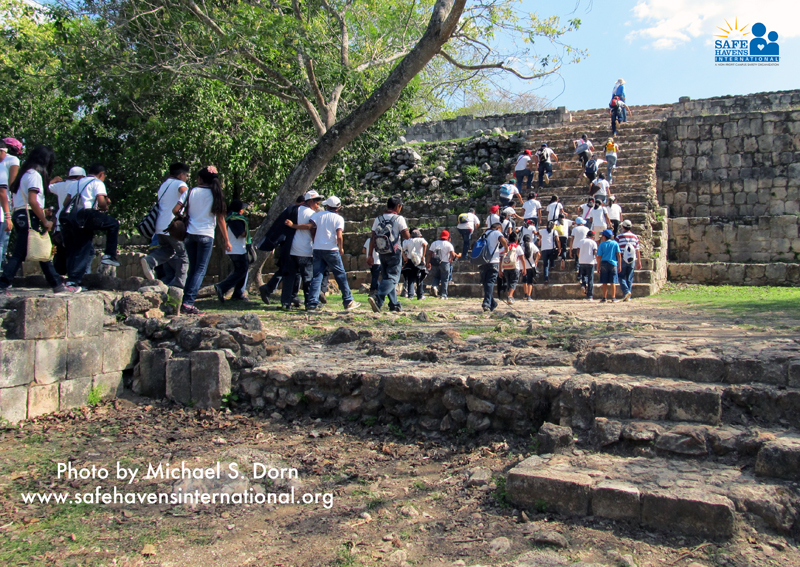
Uxmal Ruins

During a visit to the Mayan Ruins at Uxmal in Yucatan, Mexico last week, Michael Dorn observed this group of students on a field trip who were not being properly supervised.  This lax supervision could quickly result in an injury or death at a site where numerous hazards are present, and children can easily fall 20 to 300 feet if they are not extremely careful in navigating the ruins.   In a region where police officers typically patrol with a fully automatic weapon or tactical shotgun in their hands, risks from violence are also a factor as they would be in many parts of the United States, Canada, the U.K. Israel and other countries where school violence has been problematic.